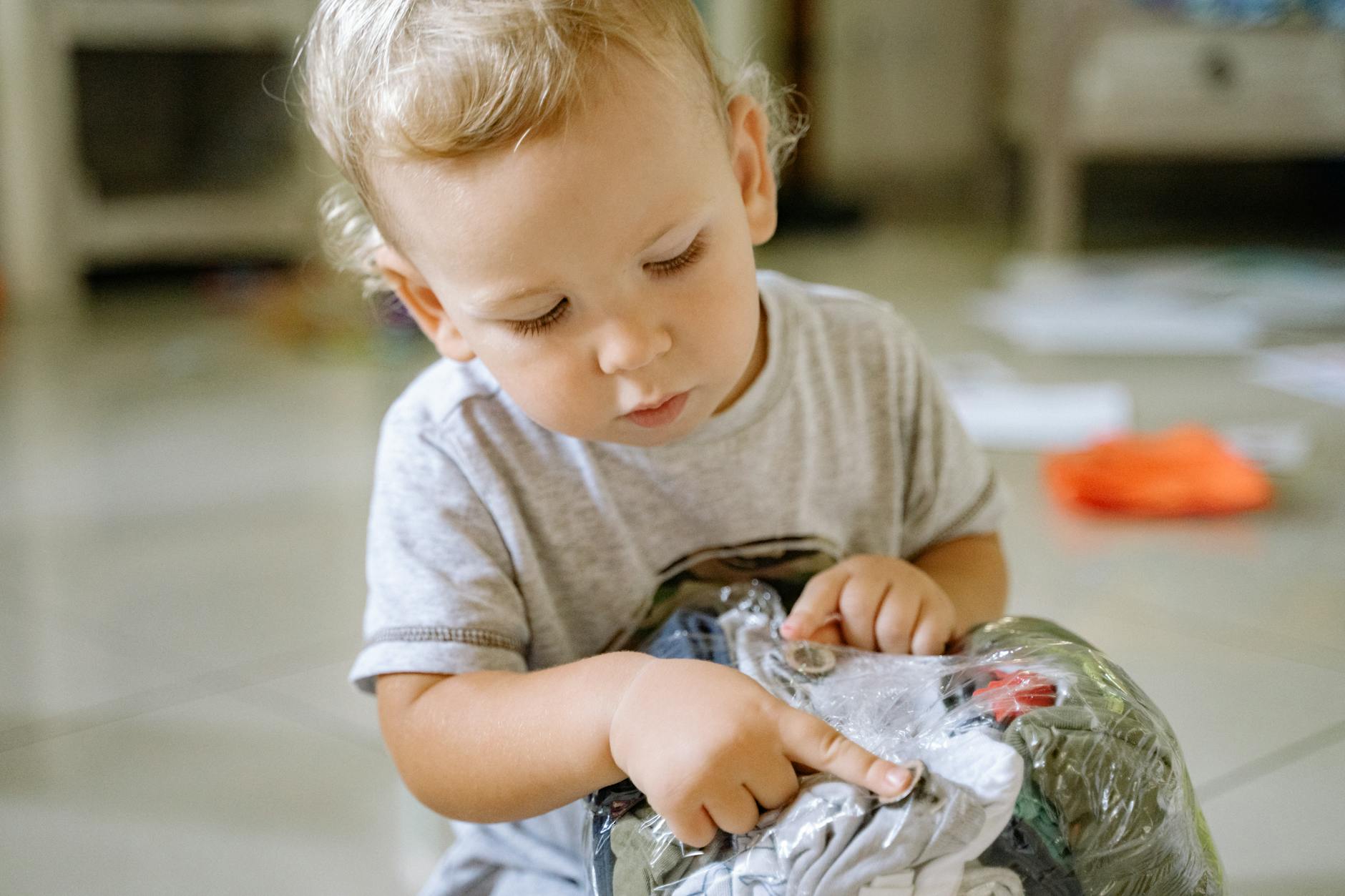
Toddlers fixate on “weird” objects — doorstops, rocks, wooden spoons, metal tins — because these items deliver unpredictable sensory play feedback that most purpose-built toys cannot match. The doorstop wobbles differently every time. The rock is cold, heavy, and gritty. That variability is exactly what a developing brain craves. A 2022 CDC milestones update reports that by age 3, around 85% of children engage in pretend play — a marker of healthy social-emotional development.
Quick Answer
Toddlers love weird objects because novelty, texture, and weight variation trigger the sensory exploration circuits that drive all early learning.
Why Is My Toddler Carrying a Doorstop Around?
Your toddler is carrying that doorstop because it is one of the most sensorially complex objects in your house. Sensory play at this stage is not recreational — it is developmental work. The doorstop compresses, bounces back, makes a satisfying thwack on the floor, and has a rubbery texture that small fingers love to squeeze.
Purpose-built plastic toys often fail toddlers because they do the same thing every single time. A button plays the same song on press 47 as on press 1. The doorstop? Every interaction is slightly different — that variability keeps a 2-year-old engaged for 45 minutes while a $50 toy collects dust. This is not a parenting failure. It is physics.
What Do Parents Actually Report Their Toddlers Are Obsessed With?
Parents in parenting communities catalog their kids’ obsessions with both exhaustion and amusement: rocks, measuring tape, sticker backing paper, packing peanuts, silicone spatulas, bubble wrap, cardboard tubes.
The specifics vary wildly, but the pattern is consistent. These objects share three traits:
- Textural interest — they feel different from smooth, hollow plastic
- Unpredictable behavior — they move, compress, or react in non-repeatable ways
- Real weight and heft — they feel solid and consequential, not cheap
A second pattern: emotional support objects emerge around 18-24 months. A specific rock carried for weeks, a particular stopper that cannot be put down — this is a transitional comfort object, functioning like a blanket does for slightly older children. It is developmentally normal. Do not take the weird thing away without a plan.
What Does Child Development Research Say About ‘Weird’ Toy Preferences?
Unstructured play — child-directed free play with no predetermined rules, goals, or adult instruction — is the primary cognitive task of toddlerhood. The American Academy of Pediatrics’ landmark 2018 report, The Power of Play, found that child-directed play with open-ended objects produces stronger gains in problem-solving, language, and emotional regulation than adult-directed activities.
Research in Developmental Psychology shows that toddlers explore novel objects significantly longer than familiar ones — even when familiar toys are labeled “educational.” The label means nothing to a 2-year-old. The wobble, the weight, and the surprise do.
Gross motor skills — large-muscle coordination including throwing, carrying, and lifting — also develop through heavy object play. A toddler hauling a rock across the yard builds the same muscle groups they will use for catch games and sports years later.
What Outdoor Toys Replicate What Toddlers Love About Weird Objects?
The key is matching the sensory variability of found objects in a safe, durable form:
| What Toddlers Love | Why It Works | Refresh Sports Option |
|---|---|---|
| Texture variation | Sensory exploration circuits | Stringy Balls & Sensory Toys ($13.97) |
| Weight and heft | Gross motor strength | Soft Stone Skippers Game ($15.97) |
| Unpredictable motion | Novelty on every throw | Airplane Toy Glider – EVA Foam ($9.39) |
| Satisfying impact | Completes the throw-catch loop | Toss and Catch Ball Game Set ($27.97) |
We designed every Refresh Sports product around one question: will this get a family playing together in under a minute? That is why the Toss and Catch Ball Game Set ($27.97) comes ready to play out of the box, the Water Flying Discs – Splash Discs ($9.97) float so they never sink to the bottom of the pool, and the Airplane Toy Glider – EVA Foam ($9.39) flies far enough to make a 5-year-old sprint. Our full lineup is built for the real way families play: mixed ages, mixed skill levels, and about 45 minutes before someone needs a snack.
Should You Just Let Them Have the Weird Thing?
Yes — with reasonable safety limits. If the object is not a choking hazard, not sharp, and not toxic, letting your toddler carry and explore it is genuinely good for their physical development. Fighting the preference burns your energy and implicitly teaches kids that their natural curiosity needs adult approval before it is allowed.
Redirect only when:
- The object poses a real safety risk (small batteries, fragile glass, sharp edges, anything that fits through a toilet paper tube for kids under 3)
- The obsession disrupts sleep or transitions in ways that are distressing, not just inconvenient
How to redirect without crushing the magic: offer an outdoor toy with similar sensory properties. A child obsessed with rocks often takes immediately to foam stone skippers or dense sensory balls — outdoor, safe, and building gross motor skills in the process.
What Happens When Kids Are Allowed to Direct Their Own Play?
Children who direct their own outdoor play — including with “weird” objects — develop stronger executive function and self-regulation than children in always-adult-structured environments. The doorstop phase passes. What stays is a child who trusts their own curiosity, knows how to entertain themselves, and is not dependent on screens for stimulation. That is worth a few weeks of rocks in the laundry.
References
- American Academy of Pediatrics. (2018). The Power of Play: A Pediatric Role in Enhancing Development in Young Children. Pediatrics, 142(3).
- Weisberg, D. S., et al. (2013). Guided play: Where curricular goals meet a playful pedagogy. Mind, Brain, and Education, 7(2), 104-112.
- Soska, K. C., et al. (2010). Systems in development: Motor skill acquisition facilitates 3D object completion. Developmental Psychology, 46(1), 129-138.
- Children and Nature Network. (2020). Children’s Contact with the Outdoors and Nature: A Body of Research.
- For outdoor activity ideas by age, visit raisingactivekids.com
- For age-appropriate outdoor gear, visit backyardplayguide.com
- American Academy of Pediatrics — healthy active living for families
- HealthyChildren.org / AAP — the power of play